
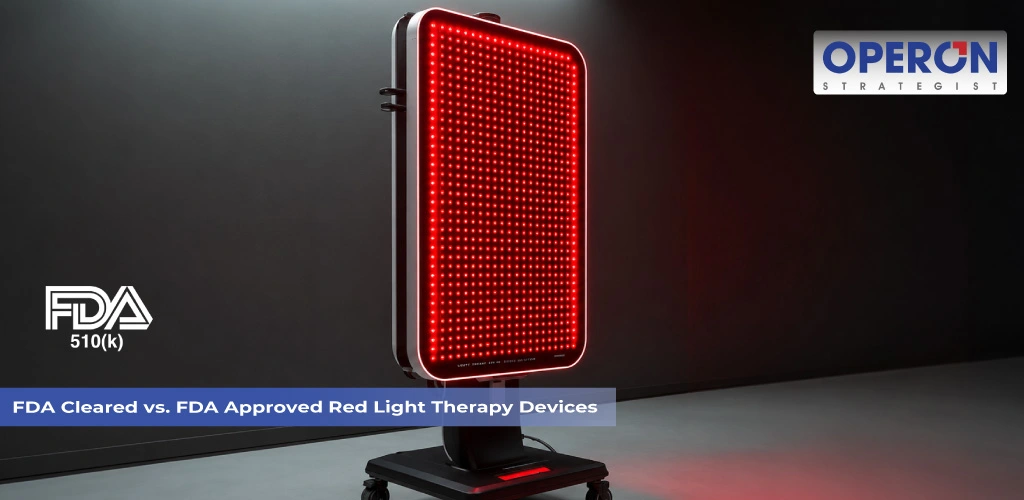
FDA Cleared vs. FDA Approved Red Light Therapy Devices: Navigating the Regulatory Maze
The global demand for photobiomodulation (PBM) technology is surging. From at-home LED face masks to full-body clinical panels, consumers are actively seeking the therapeutic benefits of red light therapy. As a manufacturer looking to enter the lucrative U.S. market, you know that regulatory compliance is your most critical hurdle.
However, if you look at consumer search trends, you will immediately spot a massive misconception. Thousands of buyers search for an “FDA approved red light therapy device” every single month.
While that is what consumers type into search engines, using that exact terminology on your medical device packaging or website can result in severe regulatory penalties, including FDA Warning Letters or product seizures.
Here is what manufacturers need to know about the regulatory realities of red light therapy, the difference between clearance and approval, and how to legally bring your device to the U.S. market.
Contact us for expert 510(k) regulatory support
The Big Misconception: "FDA Approved" vs. "FDA Cleared"
Why is the term “FDA Approved” so dangerous for red light therapy manufacturers? It comes down to how the FDA classifies medical device risk.
The U.S. Food and Drug Administration (FDA) categorizes medical devices into three classes based on the level of control necessary to assure their safety and effectiveness.
- Class I (Low Risk): Devices like bandages or manual surgical instruments. Most are exempt from premarket notification.
- Class II (Moderate Risk): Devices that require special controls. This is where most red light therapy and photobiomodulation devices sit. They require FDA Clearance via a 510(k) submission.
- Class III (High Risk): Life-sustaining or life-supporting devices, such as pacemakers. Only these devices go through the rigorous Premarket Approval (PMA) process to earn the title FDA Approved.
Because red light therapy devices pose a moderate risk to users—primarily concerning photobiological safety and electrical hazards—they do not go through the PMA process. Therefore, there is no such thing as an “FDA approved” red light therapy device on the market. They are FDA Cleared.
Expert Insight: Misbranding your Class II PBM device as “FDA Approved” is a direct violation of the Federal Food, Drug, and Cosmetic Act. Marketing teams must strictly use the term “FDA Cleared” once a 510(k) is granted.
The Danger of "FDA Registered" Claims
Another common pitfall is confusing facility registration with device clearance.
Any facility involved in the production and distribution of medical devices intended for the U.S. market must register with the FDA. However, completing your annual establishment registration and paying the user fee simply means the FDA knows your facility exists.
Facility registration does not mean the FDA has reviewed, cleared, or approved your specific device. Marketing a product as an FDA cleared red light therapy device when you only hold a facility registration is a fast track to regulatory enforcement.
The 510(k) Pathway for Red Light Therapy Manufacturers
To legally market a Class II red light therapy device in the U.S., you must submit a 510(k) Premarket Notification.
The core of a successful 510(k) submission is demonstrating Substantial Equivalence (SE). You must prove that your new device is just as safe and effective as a “predicate device” (a legally marketed device that has already received FDA clearance).
A robust 510(k) technical dossier for a red light therapy device must include:
- Predicate Identification: Pinpointing the exact previously cleared device your product is legally comparable to using the official FDA 510(k) Database.
- Performance Testing: Empirical data proving your device works as intended without causing harm.
- Electrical Safety & EMC: Compliance with IEC 60601-1 (general requirements for basic safety) and IEC 60601-1-2 (electromagnetic compatibility).
- Biocompatibility: Ensuring any part of the device that contacts the patient’s skin meets ISO 10993 standards.
- Photobiological Safety: Testing per IEC 62471 to ensure the LED emissions do not pose a hazard to the eyes or skin.
How Operon Strategist Can Help
Navigating the FDA’s regulatory pathways requires careful planning, strict timeline management, and a flawless technical dossier. Whether you are an established manufacturer or a new entrant into the photobiomodulation space, Operon Strategist provides the execution-ready expertise required to get your device cleared.
Our comprehensive Operon ElevatePlus US FDA 510(k) Services are designed to fast-track your market entry:
- Regulatory Strategy & Device Assessment: We analyze your device classification, identify the best regulatory pathway, and execute in-depth predicate device research.
- End-to-End 510(k) Submission Preparation: Our experts compile your complete technical dossier, prepare the substantial equivalence justification, and develop compliant device descriptions and labeling.
- FDA Communication Support: We submit your application via eSTAR, monitor review cycles, and handle all FDA Additional Information (AI) requests within strict timelines to prevent delays.
- QMS Alignment: We ensure your manufacturing processes align with FDA 21 CFR Part 820 Quality System Regulations (QMSR).
With a track record of successful 510(k) submissions worldwide, Operon Strategist bridges the gap between your innovative technology and U.S. market access.
Stop navigating the regulatory maze alone.
Contact Operon Strategist today to discuss your red light therapy device’s regulatory strategy and ensure your path to FDA clearance is smooth, compliant, and accelerated.
FAQ's
Are red light therapy devices FDA approved?
No. The FDA does not “approve” red light therapy devices. Because they are moderate-risk products, they receive FDA Clearance rather than approval.
What is the difference between FDA cleared and FDA approved?
FDA Approval is reserved for high-risk Class III life-sustaining devices (like pacemakers). FDA Clearance is granted to Class II devices (like red light therapy) after they prove they are substantially equivalent to a safe predicate device.
Does an FDA registered facility mean the product is cleared?
No. Facility registration is just an administrative step showing the FDA where the products are made. It does not mean the FDA has reviewed, tested, or cleared the specific red light therapy device for safety.
What regulatory pathway is required for red light therapy devices?
Manufacturers must submit a 510(k) Premarket Notification to the FDA. This submission must include comprehensive data proving the device’s safety, efficacy, and substantial equivalence to an existing cleared device.
What testing standards must these devices pass for FDA clearance?
They must comply with IEC 60601-1 (electrical safety), IEC 62471 (photobiological/LED safety), and ISO 10993 (skin biocompatibility).